
Any business looking to invest in its marketing strategy will want to ensure it gets a great ROI from its budget. But how do you decide whether to invest more in developing brand awareness through your content marketing, social media and SEO or to focus more closely on your campaigns and track every penny being spent?
If a business is looking to invest in the strategy used to market their business, then it will need to ensure it is getting the highest returns on the budget. But how do you know if you want to continue investing further in raising brand awareness through your content marketing, social media and SEO strategy or if you are going to focus a little more heavily on your campaigns and measuring every single penny spent?
Performance marketing vs traditional digital marketing is widely discussed by businesses that want the best returns on their investment. One can build a brand and the other can get instant conversions – the question is, where should a business allocate its marketing budget?
The answer to these questions would appear to be: how fast is a business growing and what do they want to achieve from their marketing ROI? This guide will explore some of the options available to any business and investigate some of the pros and cons of these differing strategies.
What is Traditional Digital Marketing?
While the phrase digital marketing refers to a myriad of online methods and techniques used to promote a business, there are core objectives that most Digital Marketing Strategies adopt. These typically centre around online brand building through content marketing, social media marketing, blog publishing and investment in SEO and other marketing activities which aim to increase visibility for your business.
As an example, a person might read a blog on a topic, become interested in your company following a social media post about the blog and months later become your customer. This means that sometimes the effectiveness of certain Digital Marketing Strategies is difficult to measure immediately.
That said, not all traditional Digital Marketing efforts have to be seen as indirect. In a lot of cases, they are essential to the building of brand and trust, although businesses can find it harder to attribute any particular sale to a Digital Marketing ROI.
What is Performance Marketing?
Performance marketing, on the other hand, focuses more directly on measurable actions and what you can achieve based on specific goals. Here, businesses aim to get a potential buyer to respond to an ad by downloading a leaflet or registering for an information pack. There are some very tangible measures of whether a set of interventions has worked, making it easier for businesses to track Performance Marketing ROI.
A well-run Performance Marketing Strategy also includes continual testing to ascertain which parts of your marketing interventions are having the most success. Different ads can be used, tested and deployed to continue to improve your marketing spend, while changing the offer, audiences, and keywords will also have an effect on this. It also enables marketers to ensure they are continuing to invest in what is working, rather than chasing what failed to pay dividends.
Performance Marketing vs Traditional Digital Marketing: Understanding the Difference
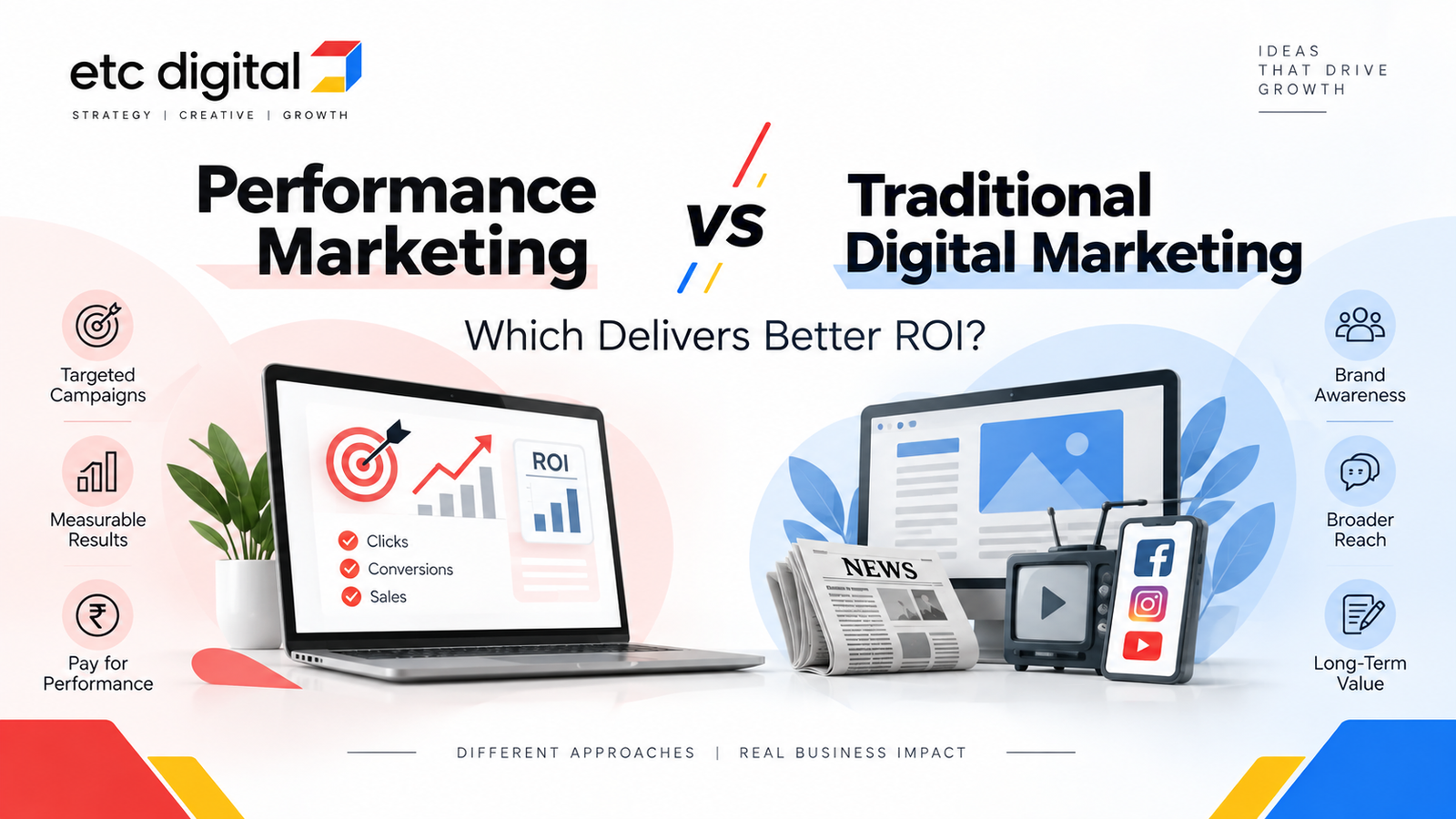
The primary distinction in the debate between performance marketing vs traditional digital marketing is the different objectives of the strategies.
While traditional Digital Marketing is concerned with brand building and increasing visibility, the primary goals of performance marketing are to directly measure sales or the number of registrations or leads a business is able to acquire as a result of its online interventions.
While perhaps an engagement on a social media post could be seen as positive, a business using a performance marketing model will focus more on how many of those users would go on and actually buy a product or service.
A fair assessment of the traditional marketing vs performance marketing debate would be to say that each approach serves a distinct purpose. Therefore, neither option is more important than the other, and it is necessary to consider how the two approaches might fit best within your wider business aims.
Which Marketing Strategy Delivers Better ROI?
When it comes to the ROI on different marketing approaches, it is possible to say that, in general, where a business is interested in immediate, quantifiable results, performance-based interventions tend to be more successful than traditional approaches. That said, it is also necessary to factor in some of the subtleties here.
While an engagement from a potential customer is positive, if the person clicks through to your website but then fails to take further action, the marketing ROI from this would prove hard to calculate and is unlikely to bring you much benefit. The question is therefore not just about quantity, but in relation to getting the right people to take meaningful actions.
That is one of the reasons why businesses are turning more to performance-based strategies. Because you can segment your audiences, see what types of advertisements are proving effective, and test what offers and keywords drive engagement most successfully.
Traditional approaches still bring value as they generate long-term brand growth. SEO, blog content or brand-building efforts may need to be deployed and monitored over a longer period of time before they begin to prove effective. However, these strategies can generate leads without ongoing advertising spend.
How Does Performance Marketing Improve ROI?
One of the core reasons that businesses turn to performance-based advertising is because of a focus on monitoring the results they obtain.
It can be beneficial to understand how performance marketing improves ROI. Performance marketing enables businesses to track metrics such as:
- Cost per click.
- Cost per lead.
- Conversion rate.
- Customer acquisition cost.
- Revenue generated from each advertising campaign.
The benefits of performance marketing for businesses are limitless. Businesses can identify campaigns generating high-quality leads at cost-effective prices and invest more in those campaigns.
Performance-Based advertising also allows us to be more efficient in our testing and experimentation. By switching up and down various aspects of your campaigns – your offer, creatives, audiences and keywords, you will be able to see what interventions most effectively improve your marketing ROI.
Because there is also a built-in option to adjust budgets at any time and move money into more effective advertising than interventions that are underperforming, you can really focus your efforts where most needed at any given point in time.
Budget Control and Better Decision Making
Another vital difference in performance marketing vs traditional digital marketing is the level of budget control that businesses are able to leverage.
With a clear view of how successful your campaigns are, the ability to alter them as needed becomes more tangible in performance marketing. The option to invest more in campaigns that have proven themselves to be effective and stop investment in those that have failed to meet your expectations provides substantial scope.
In addition, we have to remember that while not every kind of digital investment will directly result in a sale or conversion, these are nonetheless vital to the long-term growth of your business model.
A website with relevant content continues to attract website visitors for a matter of years. Good SEO will begin to show its results, while engaging your target customers via social media means that, by the time you launch any marketing campaign, you are already known to them.
Therefore, coming to the traditional marketing vs performance marketing debate, the best plan of action is probably to incorporate elements of both.
The Role Of Data in ROI in Digital Marketing
Today, data plays a governing role in ROI in Digital Marketing. Businesses now have more data on their users than ever before.
From website traffic to where they came from, what pages they visit on our website and the ad campaigns that captured their attention before they visit our website, businesses have data to make informed decisions on ROI.
This information can greatly benefit performance campaigns as businesses can continue to experiment and test their assumptions about what drives user engagement. Those campaigns with a proven record of success will be prioritised and given increased investment, with the under-performing advertising campaigns being eliminated.
That said, there are some limitations in using this purely as a metric for your marketing ROI. The cost per click figure in a particular channel could be low, but without the visitors coming to your website being interested in your product or service, this will fail to reflect the ultimate success of that intervention.
A healthy ROI requires us not to focus simply on what we can see on a spreadsheet, but to understand how the campaigns we make are affecting our business outcomes. Qualified leads, sales, engagement, and repeat purchases all count for more than raw statistics.
Should Businesses Use Both Approaches?
As has already been mentioned, the debate between performance marketing versus traditional digital marketing is an interesting one, with advantages on either side.
The traditional marketing vs performance marketing debate does not mean that businesses have to choose only one marketing approach. It is probably best to consider both approaches when it comes to making marketing decisions.
Traditional interventions will focus on brand engagement, while advertising efforts will build on that engagement to bring in new sales. Content marketing, SEO and building your social media presence create a base from which you can launch targeted advertising campaigns with the intent of turning these warm leads into actual sales. In essence, you get the best of both worlds.
Performance-Based advertising is an excellent tool that increases your ROI. Through careful budget allocations across different channels and continuous analysis of test results, you can continue to enhance your performance. A well-deployed strategy will provide you with the marketing insight you need to inform your marketing decisions, which in turn allows you to provide greater customer value.
Ultimately, a traditional strategy is an important part of any digital marketing portfolio. If you only focus on the areas that provide immediate ROI, in the long term you risk losing ground in regard to building recognition and trust among your potential customers.
At ETC Digital, we can provide you with marketing strategies that truly reflect your needs. We combine data-driven performance marketing campaigns with strong digital foundations to show exactly how our interventions are impacting your marketing ROI. We do that with the understanding that while traditional Digital Marketing interventions tend to have a lower ROI in the short-term, they have a long-lasting impact, which should not be ignored.
Whether it is building your brand visibility, generating more leads or driving your sales forward, we can help with that. Contact us to discuss your requirements today.